People Search in Greenville County offers instant access to name, address, and age data, letting you confirm a current address or trace previous residences without leaving home. By entering a name or location, the Greenville County people search lookup pulls public records, household connections, and property filings, showing linked family members and court dockets. This fast, reliable approach helps you verify identity, locate relatives, or gather background details for personal or professional needs.
When you type a Greenville County resident lookup, the system cross‑references address history, marriage records, and business filings to build a clear residence timeline. The Greenville County people finder search also highlights related people, such as spouses or parents, and flags duplicate name matches to reduce errors. Users appreciate the straightforward interface that quickly reveals public records while respecting privacy limits and opt‑out choices.
How to Search People Search
People Search in Greenville County helps match a person with public records connected to a name, address, age, or location. Available records may include deeds, court filings, vital events, business filings, and previous-address references. You can also access reverse phone to review official records. No single county resident database appears in the supplied source material, so each result needs a source check. Start with an official filing when possible, then use a second record to confirm that the name belongs to the same person.
Official Search Portal: No official government search portal was supplied for this page.
Steps to Search
- Define the exact goal before searching. Write down whether you need a current address, previous residence, family connection, property link, marriage or divorce record, court case, or business filing. A clear purpose keeps unrelated people with similar names out of the results.
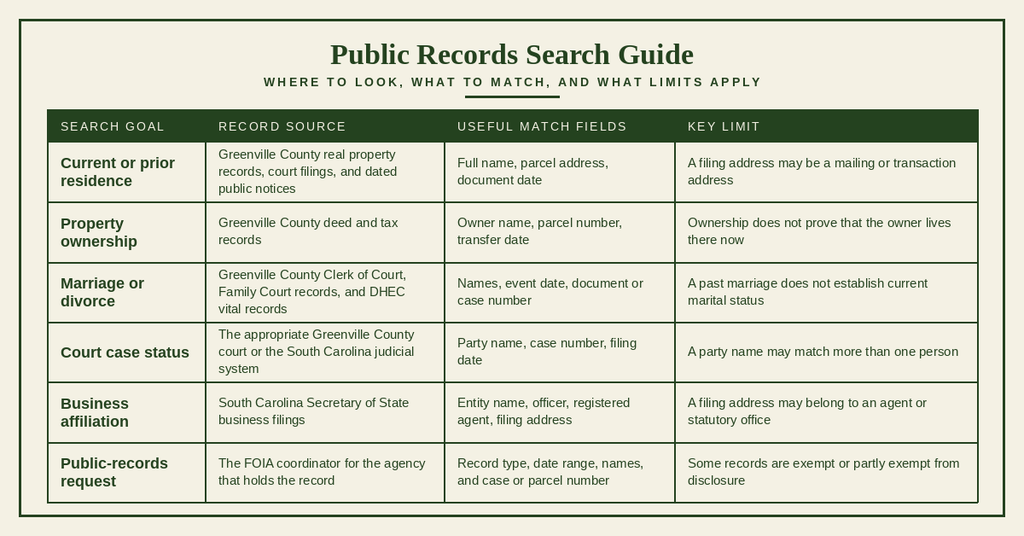
- Select the office or court that holds the needed record. Greenville County real property offices handle deeds and property records, the county courts handle many civil and family filings, and the South Carolina Secretary of State handles business entity filings. Use the relevant office rather than relying on one broad directory.
- Prepare the known search terms. Include the full legal name, middle name or initial, date of birth, current or former address, and nearby relatives when those facts are known. Keep names and addresses in separate fields so a false combination does not remove a valid match.
- Run a broad name search, then narrow it by location and age. Begin with Greenville County and the municipality or ZIP code, since a common name may appear across several states or counties. Age estimates should be treated as approximate because public directories often carry old dates.
- Compare every returned profile with the known facts. Check at least two independent points, such as a full name plus a specific address, rather than relying on one matching field. Review dates on deeds, filings, and directory entries before accepting a current-address claim.
- Verify the strongest match against the issuing office. Request the court docket, deed, marriage or divorce entry, or business filing that supports the result. An official record carries more weight than a name, age, and address assembled by a private people finder.
- Document each source, date, and result number. Keep a separate note for facts that appear only in a private profile. This prevents duplicate people records from being treated as separate people during later reviews.
- Check the agency’s current request form, office hours, and fee schedule before ordering records. Public-record copying charges can change, and third-party subscription fees are separate from government charges.
Choosing the Right Greenville County Record Source
The best source depends on the fact you need. A deed can establish a property interest, while a court filing can place a name at an address on a specific date. Neither source, by itself, proves continuous residence or current occupancy.
Person Lookup Search
A person lookup service can speed up research by combining indexed records into a single profile. Its data may come from court indexes, property databases, public directories, vital-event indexes, and private compilations. That makes the tool useful for discovery, yet the profile remains a set of linked claims rather than proof of identity or present residence. Official records should supply the final verification for high-stakes decisions.
People Search by Name, Address, Age, or Location
The most productive search uses the most distinctive fact available. A full address can narrow a common name, while a rare full name can help when the location is unknown. Searching by age alone produces many unrelated profiles, and searching by Greenville County can mix the city of Greenville with other municipalities or unincorporated parts of the county.
What a Person Profile Can and Cannot Show
A people finder may expose several records for one person, yet the profile cannot guarantee that every field describes the same individual. Read each result as a dated claim and mark unverified items before drawing a conclusion.
- A current-address label may reflect the latest directory update rather than a verified residence.
- A previous-address entry may come from a court filing, deed, or another person with the same name.
- An associated-person label may mean a shared address, a filed relationship, or an algorithmic link.
- An age may be outdated, rounded, or inherited from an old directory entry.
- A property interest may connect a name to a parcel without showing that the person occupies it.
- A business filing may connect a person to an entity through a role, agent, or officer listing rather than daily employment.
Residence History and Linked Records
A Greenville County residence history is built from dated records rather than one authoritative residence file. Deeds, tax records, court cases, vital-event filings, and business documents can place a name in different places during different periods. Sorting those records into a timeline exposes conflicts that a people-search result can hide.
Current and Prior Residence Timelines
Current-address information in private profiles should include a date. An address from a recent filing may be more relevant than one copied from an older directory. A reliable address timeline identifies the source of each entry and distinguishes the event date from the date the information was collected.
A deed or property transfer can show ownership interest and the recorded transfer date, but it cannot establish move-in dates or current occupancy. Tax records may identify a parcel, assessed owner, and assessment date, but they do not prove actual residence. Court filings can show an address listed on a dated document, while public notices connect a name and location at the time of publication. Directory entries may provide a name, phone number, and address, but they do not confirm that the person still uses that information.
Always compare dates and sources before drawing conclusions about someone’s current or previous residence.
Build the timeline from oldest entry to newest one. Mark gaps rather than filling them with assumptions. For example, a deed dated 2018 followed by a court filing from another county in 2021 may show a move, a temporary mailing address, or two people with the same name.
Linked Household and Family Associations
Household members and possible relatives can come from different record types. A marriage or divorce filing can support a specific relationship at a specific time. A shared street address can suggest a household connection, yet it does not establish kinship. Private sites often use labels such as “possible relative” without explaining the source of that label.
A marriage certificate, divorce decree, or joint filing may show that two people were married during the period covered by the record. A final divorce decree can confirm that the marriage ended on the date stated in the decree. Birth records, adoption records, custody cases, or support orders may establish a legal relationship between a parent and child. A shared address in a dated public listing only shows that two names were associated with the same location, not that they were related.
A possible-relative label based on shared addresses or other connections is an estimated association that requires independent verification before drawing conclusions about a family relationship. Use a relationship record as a search clue, not as the final identity check. A spouse’s name, a joint property interest, or a court case can lead back to the correct household faster than an exact-name search.
Associated Property and Business Filings
Property and business records often create the strongest location clues in a Greenville County people search. They can connect a person to an address at a known date, although the type of connection depends on the filing. Ownership, occupancy, registered-office status, and organizational roles carry different meanings.
- Deed: Identifies buyers or sellers involved in a property transfer and provides the property’s address.
- Tax Assessment: Names the assessed property owner or taxpayer but does not confirm who lives at the property.
- Probate Filing: Identifies people involved in an estate, such as heirs, executors, or beneficiaries, and may include related addresses.
- Corporate Filing: Lists business officers, directors, or members and may provide the company’s principal or registered-office address.
- Registered-Agent Filing: Identifies the person authorized to receive legal notices for a business. The listed address may differ from their home or office.
A business listing can confirm a name and county connection without confirming residence. It can also lead to an address history, such as an older registered-agent record followed by a filing from another county. Follow the filing dates and role labels before drawing a conclusion.
Linked Court, Marriage, and Civil Dockets
Court indexes connect names with filings, case numbers, dates, and sometimes addresses. Individuals can also check person lookup to verify relevant details. Marriage and divorce records can add family links, while civil cases may connect a person to property, money, or a business dispute. The index entry establishes the filing; the court file supplies the details.
Use the case number to retrieve the official docket and confirm party names, dates, and status. Sealed matters can hide filings, and an eligible criminal record may have been expunged under South Carolina law. A criminal listing also needs careful reading because a filed charge is not the same as a conviction or a final judgment.
Public Availability and Privacy Rules
A public record is subject to public inspection unless a law protects it, yet public availability does not mean that every field can be copied or republished without limits. Some files are open for viewing, some require a written request, and others have exempt sections. A people-search profile can also contain derived data that no agency approved as a combined profile.
Open Directory Data and Disclosure Rules
Open directory data includes listings that a source makes visible, such as filed corporate roles, indexed court parties, recorded deeds, and voluntarily listed contact details. Visibility has limits. A court index may name the parties while a sealed document stays closed, and a deed may show a parcel owner while a tax account remains partly protected.
South Carolina’s Freedom of Information Act, S.C. Code Ann. § 30-4-10 and following, governs access to many public records held by state and local agencies. Section 30-4-20 requires an agency to state whether a request is granted or denied within 10 business days after receiving it. Section 30-4-40 lists exemption categories that can limit disclosure.
- Identify the agency that created or holds the record. Property, court, vital-event, and business records sit with different offices.
- Find the agency’s current FOIA coordinator and written-request instructions. Use the form supplied by that agency when one exists.
- Describe the record with enough detail to locate it. Include full names, event dates, case numbers, parcel numbers, addresses, and a limited date range.
- State whether you want to inspect the record, receive certified copies, or obtain electronic copies when those options exist.
- Ask for the applicable search, duplication, and certification charges before ordering a large request. Third-party subscription fees do not set government copy fees.
- Review any denial or exemption in writing. Ask for the statutory basis and the agency’s appeal instructions before seeking review.
Greenville County court offices maintain civil, family, criminal, probate, and magistrate filings, which may be accessed through case indexes, clerk requests, or court records units. County real property offices provide deeds, plats, parcel data, and tax records through property searches or records requests. The South Carolina DHEC Office of Vital Records handles birth, death, marriage, and divorce records under applicable access rules.
Confidential Identity and Restricted Data
Some records are restricted because federal or state law protects them. Restrictions can cover the whole file or only a field, such as a Social Security number within an otherwise public document. Redaction permits a record to remain partly open without exposing protected details.
Law-enforcement records may withhold sensitive investigation details even when a case is publicly listed. Juvenile records are subject to state laws and court restrictions, while private personnel files may be exempt or redacted. Health records are protected by privacy laws.
Financial records may remain public after sensitive account numbers are removed. Sealed family records, including adoption and protected custody matters, may show basic case details without revealing the full file. Identity-protection material, such as victim addresses and protected witness details, may be withheld under privacy rules or court orders.
Do not treat a missing field as proof that no document exists. The agency may hold the document while withholding a protected section. Asking the FOIA coordinator which exemption applies gives a clearer answer than assuming the record is absent.
Record Removal and Privacy Opt-Out Rights
A request to remove a profile affects only the publisher that receives it. The underlying deed, court case, marriage record, or business filing remains with its source unless that source corrects or changes the record. A private people-search company can also remove its own stored profile, yet that action does not control another company’s database.
- Compare the disputed profile with the official source and list each incorrect field, such as an old address or misassigned relative.
- Send a correction request to the agency that created the record. Ask for the record to be corrected, amended, or linked to the correct case, parcel, or party.
- Send a separate removal or correction request to each private publisher showing the profile. Keep the request date, account details, and confirmation number.
- Check whether the profile reappears after cached pages and later updates are cleared. Repeat the request with the publisher if it returns.
- Seek legal help when identity theft, stalking, harassment, or a safety order requires stronger protection. A court order may address conduct or access, but it does not automatically erase every public filing.
An official record correction may amend inaccurate agency information, but it does not change copies already obtained by the public. Private profile removal may delete a publisher’s listing without changing the original government filing. A protective legal order may impose restrictions or provide remedies related to a specific case, but it does not automatically affect unrelated database entries. Criminal record expungement depends on state law and court decisions, and it may not remove every mention from private databases.
Record Accuracy and Resolution
Public people-search results can be outdated, incomplete, or mixed across people with common names. The source date matters as much as the field value, and a strong match requires agreement among dated records. Treat each profile as a set of claims until the claims line up with an official source.
Differentiating Similar Name Matches
Name matching alone is weak in a county with many shared surnames and common first names. Middle names, dates, addresses, family links, and transaction dates can separate two people with the same name. The strongest match combines several details that point to the same timeline.
Require agreement among at least two independent facts, such as a full name and exact address. If the date of birth conflicts with the official record, correct the profile rather than choosing whichever value produces more results. A conflict should remain visible until the source explains it.
Resolving Outdated Residence Data
Old residence data often appears because directories keep updating a record without removing obsolete listings. A more recent filing in another county may signal a move, yet the filing address may still be a temporary or mailing address. Resolution depends on dated sources and careful chronology.
- Check when each address was collected or filed. A property transfer date and a directory collection date describe different events.
- Compare the old address with later deeds, court filings, tax records, and business filings for the same person.
- Check whether the later address appears as a residence, mailing address, registered office, service address, or property location.
- Place the addresses in date order and label any unexplained period as unknown. Do not fill the gap with a guess.
- Request an update from the source when its record is wrong. For a current living status, seek direct confirmation through a lawful and respectful contact.
- Update private profiles only after the source-backed facts agree. Keep the old date in the residence timeline rather than deleting the earlier event.
Outdated addresses may result from copied directory data. Check newer official filings and request corrections when needed. Different addresses may reflect a move, mailing address, or second property. Compare dates and source labels to understand the differences. If no updated address appears, newer public filings may not yet be available.
Unlisted Individual Record Resolution
A person missing from a people-search result may have no indexed filing, may live outside the searched area, or may use a name variation that the database did not capture. It may also mean that no public record connects the person to the requested location. Absence from one directory does not prove that the person has no public record.
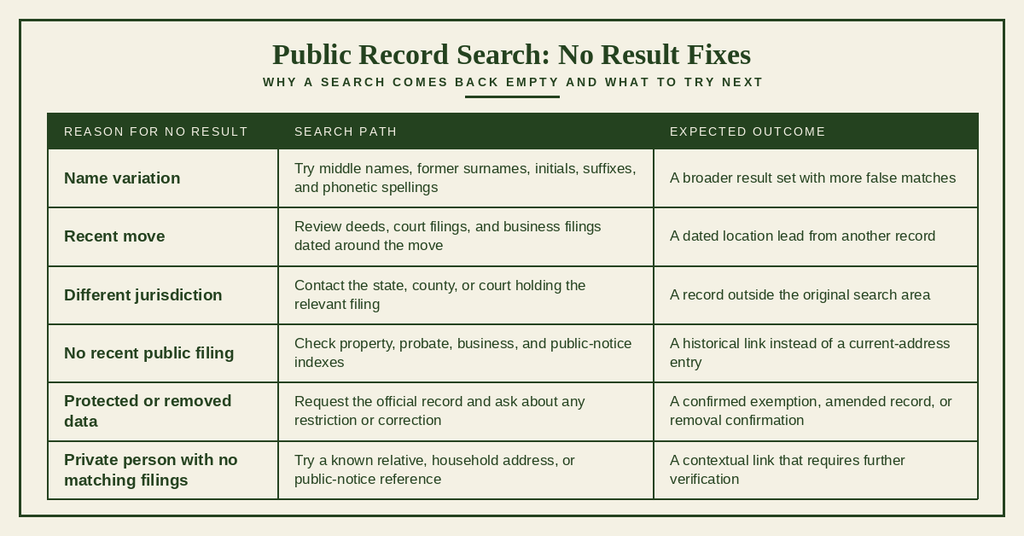
- Confirm the spelling, middle name, former name, and exact location before repeating the search.
- Search one field at a time. Begin with a unique address or full name, then inspect the results for the second identifying fact.
- Search for a known spouse, parent, child, coworker, or household member and review dated filings that connect that person.
- Check deeds, tax records, court dockets, vital-event indexes, and business filings for the relevant period.
- Extend the search to the relevant state or county when the timeline suggests a move. Send a records request to the agency that holds the needed filing.
The strongest completed result rests on a dated filing from the issuing office plus a second record that agrees on at least two independent details, such as a full name and a specific address. A profile that cannot pass those checks should remain labeled as unverified rather than presented as a confirmed Greenville County resident.
Frequently Asked Questions
Below are common questions about searching for people in Greenville County and how to use public records effectively.
How can I start a Greenville County people search?
Begin with the county clerk or recorder office website. Look for searchable databases that list deeds, court filings, or vital events. Enter the name, known address, or age to narrow results. If the official site does not return a match, try a state‑level public record portal that aggregates county data. Cross‑check any findings with a second source, such as a property tax record, to confirm the person’s identity before relying on the information.
Where find Greenville County address history?
Address history is recorded in property tax rolls and deed filings held by the Greenville County Assessor’s Office. Many counties post an online search tool where you can type an address and view past owners and transaction dates. If the online tool is unavailable, request a copy of the parcel’s record by phone or in person. Combining these records with voter registration lists can fill gaps in previous residency details.
Can I locate a Greenville County resident by name?
Yes, start with the county’s public records portal and search the name field. The system may return results from court cases, marriage licenses, or property ownership. If multiple entries appear, narrow the search using age or known city. For more precise matches, check the South Carolina Department of Health and Environmental Control for vital records that include Greenville County locations.
What records list previous Greenville County addresses?
Previous addresses appear in deed transfers, mortgage filings, and tax assessment reports. The Greenville County Assessor’s Office keeps a chronological list of owners for each parcel. Some third‑party sites also compile these public documents into searchable archives. When you locate a record, note the filing date to understand the timeline of moves and verify the address against other sources like voter registration.
How does a public people search differ from a background check?
A public people search pulls information that is openly available, such as property records, court filings, and vital statistics. A background check often includes additional data like credit history, employment verification, or criminal records that may require consent or a fee. Public searches are useful for confirming basic details, while background checks provide a deeper, sometimes more sensitive, profile of an individual.